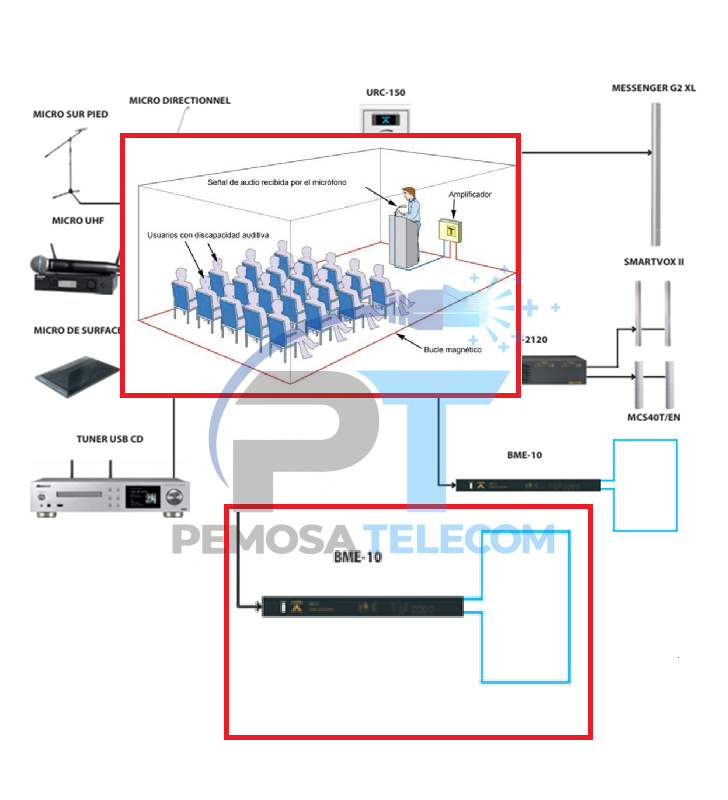
An **induction loop** (or magnetic loop) is an electromagnetic system consisting of a conductive wire arranged in a ring or coil shape that generates or detects a magnetic field based on **Faraday's law of induction**.
Depending on the context of its use, it serves various primary functions:
**1. Hearing accessibility (Magnetic loop)**
* **How it works:** It transmits an audio signal directly to the hearing aids or cochlear implants of people with hearing impairments.
* **Application:** It is installed around the perimeter of a space (theaters, service counters, classrooms). The audio signal travels through the wire as a magnetic field, and the hearing aid's coil (set to the *T* or *Telecoil* position) converts it back into clear sound while filtering out background noise.
**2. Traffic and vehicle detection**
* **How it works:** It detects the presence or passage of large metallic objects that alter the wire's inductance.
* **Application:** It is installed beneath the asphalt on roads and in parking lots. When a metal car is positioned over the loop, the electromagnetic change sends a signal to trigger traffic lights, open automatic barriers, or count vehicles.
**3. General physics and electronics**
* It forms the operating basis for **transformers**, **wireless chargers**, and **induction cooktops**, where the current flowing through an inductor loop induces a current or generates heat in a second element without direct physical contact.
A magnetic induction loop is an accessibility system that converts an acoustic audio signal into a magnetic field to transmit voice or music directly to the user's hearing aid or cochlear implant, eliminating background noise, reverberation, and distance-related issues.
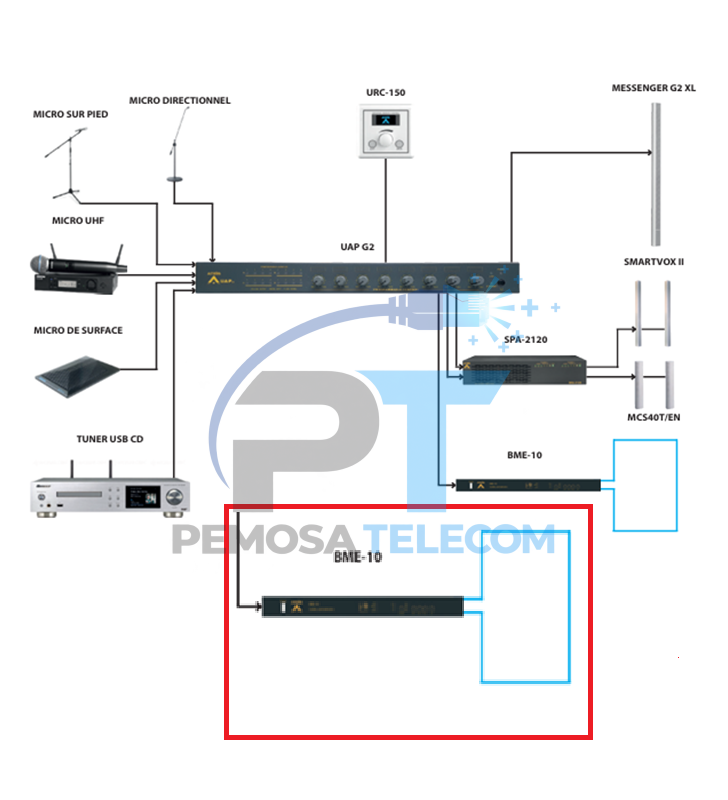
Signal chain components
1. Audio input (Capture): Originates from a microphone, a public address system, a mixing console, or a television. 2. Loop amplifier: Unlike a conventional audio amplifier (which delivers voltage to speakers), this device regulates the electric current flowing through the conductor cable to generate a magnetic field proportional to the audio signal.
3. Loop cable (Transmitter): A copper wire installed around the room's perimeter (in the floor, baseboard, or ceiling) or at a service counter.
4. Telecoil (Receiver): A tiny copper coil integrated into the hearing aid or cochlear implant.
1.1. Conversion of audio to current:
In the dedicated amplifier.
Sound captured by the microphone enters the dedicated amplifier. It processes the signal using automatic gain control (AGC) to prevent peaks and maintains a constant current flowing through the loop cable.
2.2. Generation of the magnetic field:
Ampère/Faraday principle.
As alternating current flows through the perimeter cable, a magnetic field is generated within the enclosed area. The intensity of this field varies in frequency and amplitude, exactly mirroring the rhythm of the original audio.
3.3. Induction in the hearing aid:
Reception without physical contact.
When a person with hearing loss enters the loop zone and switches their hearing aid to the T (Telecoil) position, the device's internal coil intercepts the magnetic field. Through electromagnetic induction, it generates a small current identical to the original signal.
4.4. Conversion to clear sound:
In the user's ear.
The hearing aid processes this current, amplifies it according to the user's specific hearing profile, and sends it directly to the ear, completely isolating it from ambient room noise.
Key technical and operational advantages:
*Feature: Direct benefit
*Optimal signal-to-noise ratio: The signal arrives clearly, avoiding room echoes and audience murmurs.
*No external receivers: The user does not need to borrow equipment or use additional headphones; uses their own personal device.
*Universal standard: Operates under the international IEC 60118-4 standard, ensuring that any hearing aid with a telecoil works with any certified loop system worldwide.
*Unlimited simultaneous use: A single loop covers everyone within the coverage area without bandwidth saturation.


 Copper
 RJ45, RJ0, RJ10, RJ12 Network Connectors
 Patch-Cords, Extension Cords, Red Cords
 Category 8 Patch Cords
 Category 7 Patch Cords
 Category 6A Patch Cords
 Category 6 Patch Cords
 Category 5 Patch Cords
 Patch-Cords, Extension Cords, CAT3 Voice Cords
 Patch-Cords, Extension Cords, Cross Over Cross Cords All Categories
 Cables LAN-RED (todas las categorias)
 Copper PigTails
 Pdc (Network Consolidation Points)
 PdC Trunks and Pre-assembled RJ45 NETWORK (Male/Female)
 PdC Trunks and Pre-assembled RJ45 NETWORK (Female/Female)
 PdC Trunks and Pre-assembled RJ45 NETWORK (Male/Male)
 PdC Preassembled Panels Mirror Format
 LAN Components (Network)
 Empty 19" Panels RJ45
 Intelligent Structured Cabling Systems
 NETWORK, LAN, E+E Security Components
 Voice, Telecom & ICT2
 FTTH, Voice and ICT cables (all categories)
 Tools (Voice and Data Tools) LAN - NETWORKS
 Fiber
 Connectors Fibra òptica
 Fiber Optic Cables
 Cable Fibra Óptica Interior Ajustado y Holgado
 Loose Fit Indoor/Outdoor Dielectric Fiber Optic Cable
 Loose Metal Outdoor Fiber Optic Cable
 Fiber Optic Rosettes
 Fiber Optic Patch-Panels
 Fiber Optic Wall Boxes
 Fiber Optic Wall Boxes Interiors
 Fiber Optic Wall Boxes Outdoors
 Fiber Optic Cassettes
 Torpedoes and Boxes Exterior Bleeding Fiber Optic
 Pig-Tails Fiber Optics
 SFiber Optic Splitters
 Fiber Optic Attenuators
 FTTH
 Special CPD Channels
 Rack
 Wall Racks
 Exterior Racks Ip__
 Floor Racks
 Server and Cube Racks (CPD´S)
 Chassis, Uprights, Open Frames
 Soundproof Racks
 Refrigerated Racks
 Accessories Racks, Cupboards, Cabinets
 PDU IT Smart electrification
 PDU IT Phase Metering
 Monitoring and Control of CPDs and Technical Rooms
 DIN rail
 PDU IT with monitoring
 Sensors and CAN devices
 Extensions
 Analog Sensors
 Cameras
 AC/DC Meters
 Accessories
 Power Supplies
 Cables
 Guarantees
 CPDs Data Processing Center
 ICT2 Common Infrastructures for Telecommunications
 BOX
 Wall Technical Boxes
 Technical Boxes Office Furniture
 Electrical Sockets, Schukos for Modular Boxes
 Voice and Data Boxes (Rosettes)
 Modules, Data Plates for Modular Boxes
 Floor-mounted Technical Boxes, Towers and Columns
 Organization of Cables, Management of Cables
 Channels, Trays and accessories
 Connection and Fixation Systems
 Modules, Data Plates for DIN Rail in copper and Fiber Optics
 ACTIVE COMPONENTS
 Switches without management
 Smart Switches (smart)
 Industrial Switches & Routers
 Media Converters NIC Cards and Multimedia Converters. SFP/SFP+Transceivers
 PLC PowerLine, Home Automation & Repeaters
 PoE (Power Over Ethernet) SWITCH and Injectors
 Router, Wireless & Access Point
 IPTV
 Distribution Sound, Presence
 Special Cables for Sound Distribution, Intrusion and Presence
 Public Address System Modular
 Public Address Controls and Centrals
 Public Address System 100V
 Public address system Compliance with EN54/16 and 54/24 regulations
 Common Material Public Address System
 Public Address Common Material 100V Speakers
 Intercom Systems
 Attendance control
 Home automation
 Power Supply
 PDUs without intelligence and Basic Electrifications
 Power Cables and Connectors
 SAIS UPS
 LED Technology
 MULTIMEDIA
 Multimedia Cables
 HDMI & HDMI Spliters
 SUB-D.DSUB
 Speaker Stands, TV, Projectors. Turntables
 VGA
 RCA
 FireWire
 JACK
 CANON XLR
 USB & USB Electronics
 TOSLINK
 Phones and Test
 Coaxial
 Coaxial Cables
 Coaxial Connectors
 Coaxial Adapters
 Coaxial Baluns
 Plates and pletics with female connectors / or coaxial female/female adapters
 Coaxial Extensions
 19" Coaxial Panels
 SMATV / ICT2
 Useful Coaxial Tools
 KVM
 DISPLAYPORT
 Interface Multimedia Media Converters
 CCTV
 Special CCTV Cables
 CCTV Cameras
 Recorders
 CCTV Monitors
 CCTV Tools
 Tools and Consumables
 Tools Cooper System (Copper, Networks, LAN)
 Crimping Tools (insert) RJ45, RJ10, RJ11, RJ12
 LAN Tools Kits (Networks)
 Insertion Tools 110/LSA-PLUS AND HANDLING
 Testing and pinning equipment
 Identification Tools and Consumables (Labels)
 Tools for Optical Fibers
 Kits Consumables and Velcro Ties
 Fiber Optic Case Kits
 Inspection Equipment
 Launch Coils
 Fiber Optical Strippers-Cutters
 Cleaning Supplies and Products (consumables) Fiber
 Multipurpose tools
 Electrician Tools
 Identification Labels
 Industrial entornos mas extremos
 Información Técnica, Glosario, Terminología y Explicaciones
 Patch-Cords, Jumpers, Trunks, Fiber Optic Hoses
 Jumper, Patch-Cord, extension F.O. FC/FC
 Jumper, Patch-Cord, extension F.O. FC/LC
 Jumper, Patch-Cord, extension F.O. FC/SC
 Jumper, Patch-Cord, extension F.O. FC/ST
 Jumper, Patch-Cord, extension F.O. LC/LC
 Jumper, Patch-Cord, extension F.O. LC/MTRJ
 Jumper, Patch-Cord, extension F.O. LC/SC
 Jumper, Patch-Cord, extension F.O. LC/ST
 Jumper, Patch-Cord, extension F.O. SC/SC
 Jumper, Patch-Cord, extension F.O. SC/ST
 Jumper, Patch-Cord, extension F.O. ST/ST
 Mallets, Hydras. Hoses F.O. Trunks
 Jumper, Patch-Cord, extension F.O. ST/MTRJ
 Jumper, Patch-Cord, extension F.O. SC/MTRJ
 Jumper, Patch-Cord, extension F.O. FC/MTRJ
 Delivery policy
 Return policy
 Security policy